TheBlindCow

27 April 2012

You’re welcome to KDevelop!

Filed under: KAlgebra,KDE,KDevelop,my projects — apol @ 3:28 am

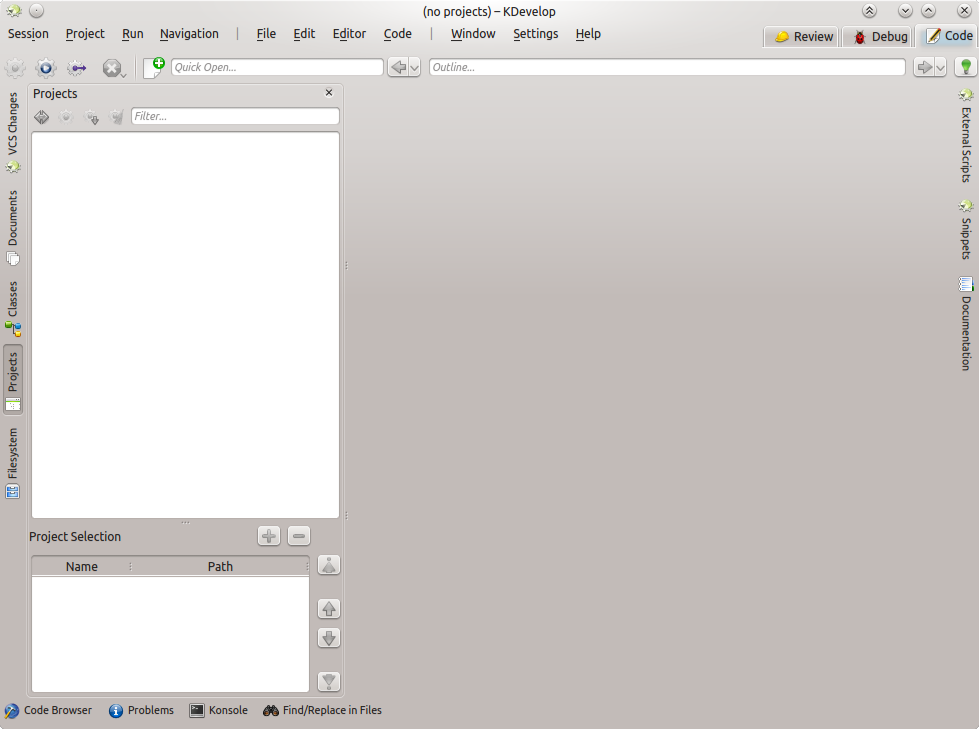
Sometimes it’s hard to get started using a tool, some people call it white page syndrome, in KDevelop we had the gray page syndrome:

kdevelop the gray

I guess you see what I mean.

To solve this problem we discussed many times about creating some way to Kickstart a KDevelop session properly, this is what I came up with. It’s nothing very different from what others do, but it’s ours, so that makes it immensely awesome. I guess you’ll understand about it easy by putting a video, looking forward to your feedback!

24 April 2012

KAlgebra on Android

Filed under: Android,KAlgebra,KDE,KDE-Edu,Software Libre — apol @ 4:29 am

Since I started blogging I’ve talked many times about KAlgebra. Usually it’s not to display it’s awesome features but to discuss its portability. I’ve always considered that it’s important for KDE not to lock down its applications to a platform. That’s why I’ve put my efforts into ensuring KAlgebra will work properly on different platforms so far, like the N9 and Plasma Active.

– TL;DR: you can jump to the video :)

I think we’ve done a great job so far. It hasn’t been easy and we are not there yet, but I think that being able to do things like this is an awesome opportunity for projects like KDE Edu where we want to target the widest audience possible.

Android offers this, a widespread audience where we will be able to put our things. That’s why I put my interest in it, anyway.

Regarding the actual implementation, it’s far from perfect. It’s using KAlgebra Mobile, which has different backends. I created a new one that doesn’t require any components present. QtQuick components are lacking for Android at the moment, so I came up with this UI that besides not being properly integrated it works good enough and keeps me from frustration. Things are looking good on that regard, apparently I’m not the only one needing those, so I hope we’ll get some proper UX eventually.

A lot is left to be done still: Integration with the system, integration in the Market, etc. Ideas welcome.

Oh, and last but not least, big thank you for Marijn Kruisselbrink who put up with my questions and opened the path by adapting kdelibs.

And now, the video.

Almost forgot, if anybody wants to try it, you can download the installer here. Remember, it eats easter bunnies.

25 November 2011

Akademy-fr FTW!

Filed under: KAlgebra,KDE — apol @ 10:47 pm

Hi!
It’s been a good day today!

First of all I arrived to Toulouse where Akademy-fr is going to happen. I’m really happy of being part of this first (I hope of many) Akademy-fr edition. :)

Secondly, KAlgebra has been accepted to the OVI store. As far as I know, it’s the first (I hope of many, again :) ) application bundling kde libs in it. So all N9* users can install it without ugly tricks! \o/

Proof: KAlgebra at OVI store.

Salutations dès Toulouse!!

3 October 2011

KAlgebra Mobile and QtQuick

Filed under: KAlgebra,KDE — apol @ 2:25 am

Some years ago I’ve been talking, whining maybe, about how KAlgebra is more flexible than it looks, the proof is this post from 2009. A lot of time has passed since then, not as much work on KAlgebra as I’d have wanted, but we are much further. Having an N900 gived me the confidence to work on a KAlgebraMobile that probably nobody tried but most of you have installed on your system, yay! It was quite a disaster, bad timing (end of N900 era) and kdecore didn’t make it to the main repositories for some reason I can’t understand, so I that version will stay in our hearts and vcs logs but not much further.

I have this little flaw, whenever I find a new cool technology I fantasize about porting KAlgebra to it. Same happened with QtQuick (QML back then), it made sense: I always wanted to have KAlgebra working on a handheld device and there we had some good opportunity. The big problem was that I didn’t want to make KAlgebra Mobile a Harmattan application, or a Fremantle, or build the GUI from scratch, since most of you will know I’m no designer. The whole QtQuick application development process looked fuzzy to me (and still does, but less).

The whole thing changed when I was asked to try QtDesktop Components, mostly because I had to try it on something and I finally could invoke something like “Button {}”. Once I had it working, I created separate implementations for harmattan and desktop, so right now it’s quite easy to extend to different sets of components quite easily as long as they are a little API-equivalent.

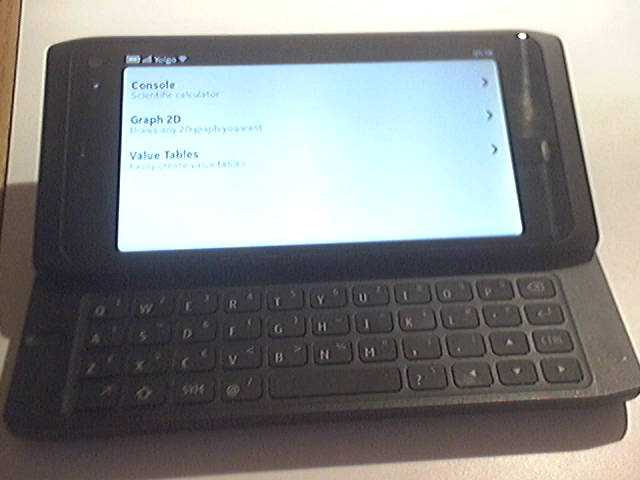
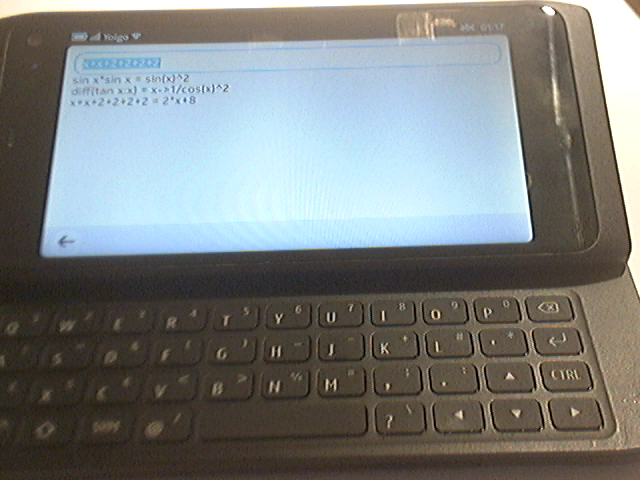
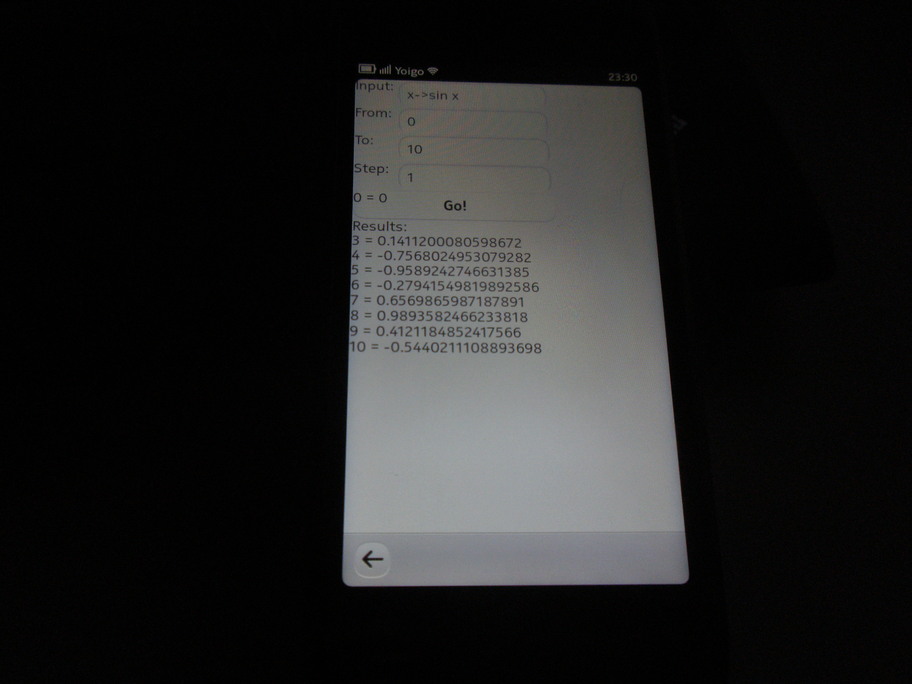
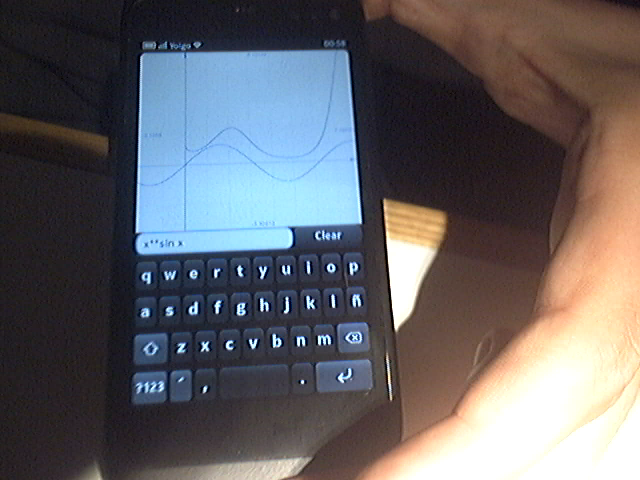
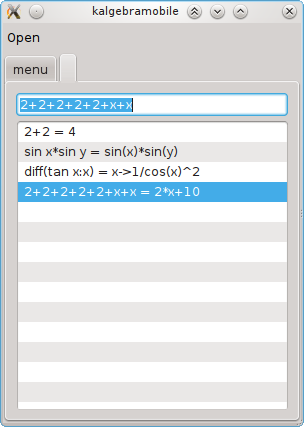
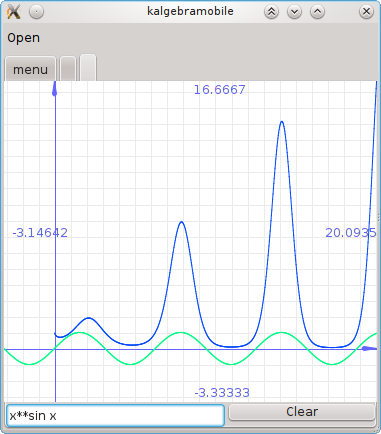
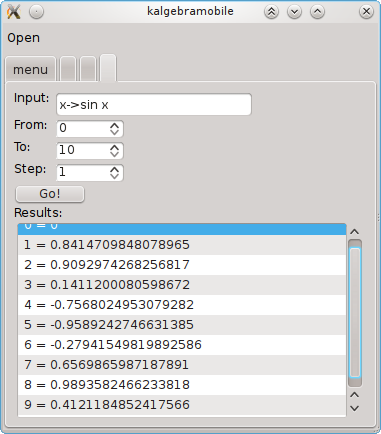
In short, right now we have a KAlgebraMobile applications that can be tested and used on desktop and also used on Harmattan. It’s far more interesting the second case, mostly because on the desktop we’ve had a version of KAlgebra since many years and I didn’t have to blog about it. Anyway, as always, it’s on kde’s KAlgebra master branch, feel free to test it. If you don’t feel like, enjoy some pretty pictures!

And last but not least, big thanks to Laszlo Papp for working for KDE in Harmattan, without his work this wouldn’t have been possible. Also big thanks to Jens Bache-Wiig who is caring about desktop even if he can do mobile UI’s :) . This kind of people make this community alive and prosper!!

24 March 2011

April of KDE

Filed under: KAlgebra,KDE,KDE-Edu,KDevelop,my projects,Software Libre,talks — apol @ 4:53 pm

Hi!
Some intensive days are coming let’s talk about it a little :) .

Next week I’ll be going to San Francisco because I’ll be attending to Camp KDE. It’s specially interesting to go there because it’s a very nice opportunity to get in touch with a KDE community that is not usually around in the events I’ve been going (it’s going to be my first KDE meeting outside of Europe). There I will be talking about KDevelop and KDE Edu (no wonder), two beautiful projects from a beautiful community like KDE, can’t be more proud of it :) .

I'm going to Camp KDE!

The day after I come back I’ll be going to Bilbao where we’re celebrating this year’s KDE Edu sprint. I feel like it’s an important step for KDE Edu because it will be the first time where we are celebrating it in an education context and because we will be gathering some important people from this country who is interested in education. Hopefully we will be able to take our project to the next level, so yay us! (again :) ).

I'm going to the KDE Edu Sprint!

And last but not least, I’ll be going to Vigo the week after that, where I will give the KDE talks in the Free Software master by the Universidad Rey Juan Carlos and Igalia. I’m happy to see these initiatives happening here and proud to help to take it to the next level. (yay us! bis bis).

Universidad Rey Juan Carlos

And last but not least, thanks to all the sponsors the KDE eV board and, in the end, all the people who makes this kind of things possible :) . See you soon!

4 February 2011

Social KDE

Filed under: KAlgebra,KDE,KDE-Edu,KDevelop,Software Libre,talks — apol @ 3:20 am

In barely 5 hours I’ll be taking my plane to Bruxelles, on my way to FOSDEM, where I’m going to meet a bunch of people interested on a lot of things like I do, mainly Free Software (and chocolate :D , but that’s off topic I guess). Also there I’ll be talking about KDE in Education at the Cross Desktop devroom. I’d like to tell anyone interested on education to come and share with us their opinion and thoughts regarding Free and Open Education.

I’d also like to remind you all that we’ll be celebrating the KDE 4.6 dinner in Barcelona (well, this time Badalona, but it’s still close :) the next 19th february, if you want to come, please just follow these instructions: http://community.kde.org/Promo/ReleaseParties/4.6#Barcelona

Last but not least, it would be good that anyone interested in coming to this year’s KDE Edu sprint says so on KDE Edu mailing list so that we have a correct appreciation about how much people is interested in coming. There will be hacking, talks to the local community and lots of fun with the local folks in Bilbao :) .

See you soon!

25 October 2010

KDE on the Mobile

Filed under: KAlgebra,KDE,my projects,Software Libre — apol @ 11:10 pm

Hi fellow KDE enthusiasts!
I know this may sound like a rant but I think that if I don’t say that I’m going to explode.

First of all, it’s great that since we’re based on Qt as a development environment we have the opportunity to get in the mobile sector. It’s not great, it’s awesome. I’ve been willing to develop there for many years and with the new Nokia platforms I will be able to use my projects there. After getting the N900, I have developed 3 applications in Maemo, just one of them has been released in the open. For Qt projects, it just works.

Let’s focus on KDE now.
- Everybody tells me that we should develop for Meego: for Meego we don’t have any KDE packages whatsoever (or at least I couldn’t find them) and AFAIK there’s no device that ships it and there won’t be any until 2011, I can put it but not even Nokia supports it. Yes, it’s a great target.
- I have Maemo, it’s an awesome Debian and there’s even some packaging already done in files.kolab.org/local/maemo/. These packages are good for testing, I could compile KAlgebra in my scratchbox. My problem with these packages is that they depend of some Qt4.7 experimental, so kdelibs in Maemo depend on something huge that I don’t need . Additionally we don’t have kdelibs packages in Maemo repositories (there are -devel repositories, it’s not like we have to stuff anything on Maemo systems), that means that if I wanted to release KAlgebra in Maemo I should add them? Doesn’t sound very community friendly.
- Why does KDE people keep telling me to trim KDELibs usage? KDELibs is useful, it makes no sense to not use it just because we don’t have packages for it. We want to share code! It’s what has made KDE great since I’ve been around at least, why do we forget that as soon as we don’t find KDE packages on some system?
- Why isn’t there people interested on packaging KDE on these systems? Probably because these distributions aren’t community-friendly enough, or because these don’t have enough users. Personally, I like to focus on development, do we really expect to push these platforms if not even developers can’t have their applications on their devices to be able to test them.
- Is it that creating packages for these platforms is just technically hard? Maybe we should address that first.

Going back to my experience, it was such straight forward with Qt apps that I convinced myself to port KAlgebra, now i have a version that just uses kdecore and kdeui (according to KDAB packages kdecore+kdeui+kalgebra, this should be less than 2MB, instead of the >10MB if I use their packages with their dependencies).
I guess that KDE development on mobile devices is kind of stale because the only applications that have been ported are huge (like Plasma or Kontact) or they just don’t use KDE (like Marble or Qthello which forked KReversi somehow, AFAIK). What would happen if we consider KDE a project and work together a little? I’m pretty sure we could bring KDE Edu or KDE Games all together into Maemo with little amount of work, why do we have people who would contribute these stopped because the lack of packaging in Maemo?

Maybe I should just consider that KDE is not supported on these devices and spend my time somewhere else.

PS: I didn’t mean to despise anybody’s work. It’s not hatred, just frustration.

14 September 2010

Free Software Day

Filed under: KAlgebra,KDE,KDE-Edu,me,my projects,Software Libre,talks — apol @ 3:23 pm

This saturday we will be celebrating the Software Freedom Day in Barcelona. I’ll be attending and I’ll talk about KDE and Education.

If you’re close and interested on the subject feel free to come and we will discuss anything you like! :)

See you there!

28 May 2010

Buzzing

Filed under: KAlgebra,KDE,KDE-Edu,me,Software Libre,talks — apol @ 2:02 pm

I haven’t found the laptop of my dreams yet (yes, I’m a romantic, probably I should write some series about How I Met My Laptop when I’m done) but life has not stopped, au contraire, it just kept moving on.

For starters, I spent last week with the KDE Edu and KDE Multimedia teams in Randa where we gathered to get our projects some steps forward. Personally it was a great experience, I was actually looking forward to discuss some issues with the KDE Edu people mostly and I think we did great, we’ll see how it turns out in the future but I’m quite optimistic about it :) . Also I could meet Percy, our new KAlgebra contributor in person, so we could discuss about some technical issues we found and about how are we going to rule the world in the future. :D
On the other hand, with my Kamoso developer hat on, it was a nice experience also to get to talk to some VLC developer to sort our problems out which is going to mean a new version soon. \o/ Great, and kudos to Alex who is doing some really tough work (VLC has bugs too! we had a hard time to realize that). And last but not least it was great to be able to show KDevelop to some KDE developers who had not realized its awesomeness yet, I even think I convinced some of them so, yay us!

Other than that, I keep working on my GSoC, I’ll have some flash visit home tomorrow and much more to come :D .

7 November 2009

KAlgebra Everywhere

Filed under: KAlgebra,KDE-Edu,my projects,Software Libre — apol @ 4:50 am

Today when I got home I felt like doing something big, something new and something fast. As many other times, this turned into some KAlgebra coding rush but today it was a bit different, because it involved a new project in KDE: Cantor.

So what happened? Cantor is an interface for mathematical engines (supports Maxima, Sage and R) that works on worksheets instead of just a console as we do in KAlgebra currently, like many other programs that you might know like Maple for instance. What I did was to implement a KAlgebra backend for Cantor.
I have to say it was quite straightforward. Alexander Rieder, the developer, has been helpful and everything worked fine, which is great and surprising for such a young project, so kudos for Cantor! :)

This backend already supports code completion, syntax highlighting and some embedded help, it doesn’t support plotting or latex exporting ¿yet? though, but I hope this will be added at some point. I’d like to remark that it’s good to have such backend because it makes Cantor a project that properly integrates the tools that KDE-Edu provides and doesn’t just rely on (probably better) choices from 3rd parties.

So now we have 4 KAlgebra interfaces: GUI, Console, Plasmoid and Cantor. What’s next?

Here you can see what it looks like:
Cantor with KAlgebra

Cantor with KAlgebra showing help

Enjoy!

Next Page »

Powered by WordPress